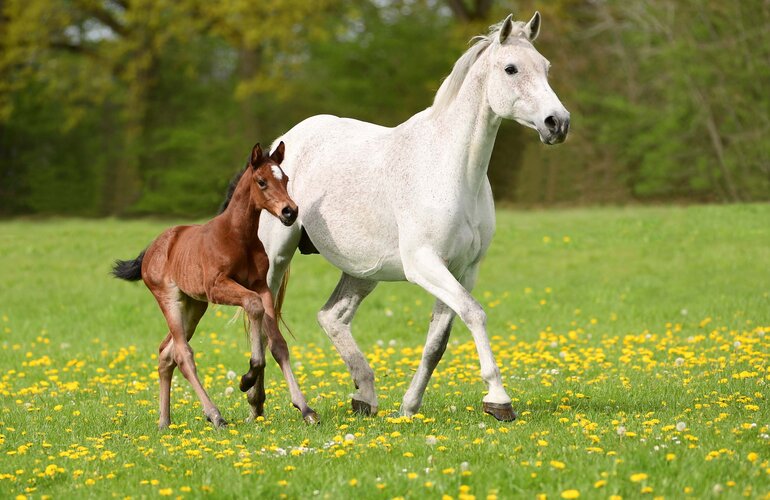
Embryo transfer (ET) as well as egg cell recovery using the so-called “ovum pick-up“ (OPU) followed by in vitro production (IVP) of embryos are lawful and approved animal breeding methods (under chapter 4 of the Animal Breeding Act/ TierZG), which also affect the Holsteiner horse population. On principle, all methods should only be used after careful consideration and on a quality-over-quantity basis, without narrowing the genetic diversity.
Embryo transfer (ET) is a procedure already used where the egg cell is fertilized in the donor mare’s fallopian tube. After only a few days the embryo is flushed from the donor mare’s uterus and transferred into a recipient mare which takes over the job of carrying the pregnancy to term, birthing and raising the foal.
Unfertilized egg cells can be retrieved from a donor mare through sonographic directed transvaginal puncture of ovarian follicles (OPU). Essentially, the subsequent in vitro production (IVP) of embryos involves three methodological steps: in vitro maturation IVM), in vitro fertilization (IVF) through equine intracytoplasmic sperm injection (ICSI) and in vitro culture (IVC) until an about 7-day-old embryo has developed. Same as with ET, the produced embryo can be either frozen or transferred into a recipient mare right away.
The Holsteiner Verband board advises breeders and members to use the reproductive techniques outlined above in the following way:
Embryo transfer (ET):
- Use of donor mares with high genetic and/or sport quality
- Use of recipient mares (not too old) with good fertility, sufficient size and nice personality
- Good care and health management of donor and recipient mare
- Should be performed only by qualified professionals, preferably during the natural breeding season
- A maximum of three flushes per mare/year
Ovum Pick-Up (OPU):
- Use of donor mares with high genetic and/or sport quality
(as the case may be also mares with acquired fertility disorders)
- Use of donor mares which have already produced a foal
- Procedure performed only by qualified professionals
- Follow-up inspections of donor mares required
- A maximum of three egg cell recovery sessions per season should produce no more than five offspring at most
- Three breeding seasons in succession at most
- Economic gain should not be the main object
Stallion Selection for Intracytoplasmic Sperm Injection (ICSI):
- Targeted use of particularly high-performing Verband approved stallions with limited semen availability
- Look out for fitness for breeding (normal fertility), to avoid negative selection
These basics drawn up by the Holsteiner Verband should be seen as a recommendation for the Verband members which are called upon to act with utmost responsibility and adhering to ethical and animal welfare principles. The decision to use the respective reproductive techniques is at each breeder’s personal discretion.