The IAFH makes it possible. “Modern Biotechnology enables us to give important information to breeders – building parts which can help to breed even better and healtier horses“, says the president of the International Association of Future Horse Breeding (IAFH), Dr. Wolfgang SchulzeSchleppinghoff.
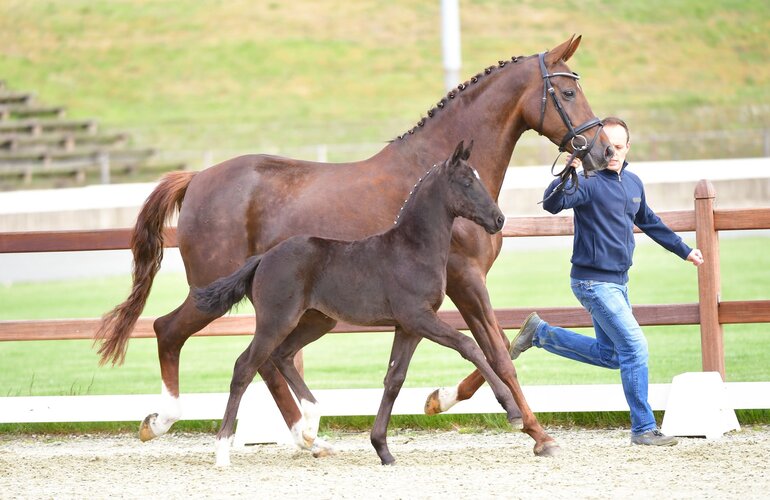
An impressive example for use of the new method in practice is the prediction of the coat colour of the foal. Colour is predictable – provided there is more known about the parents than is usually the case. For a better understanding: There are genes which decide whether a foal is born as a chestnut and others which define whether it will be bay or black. If the breeder knows about the gene locus of the two basic colours (chestnut and bay or black respectively) of the dam and the sire, then a ‘colour on request’ is plannable. Depending on the genotype, a black foal could be guaranteed even if the chestnut dam is matched with a black sire whose genetics have been sequenced. Hoping for the best and being sure only after a lot of foals will be history – one look at some important and well known markers will be enough.
In 2016, it was a visionary idea which led to launching the International Association of Future Horse Breeding (in short: IAFH): By using the ne- west scientific knowledge combined with the latest laboratory analysis and methods of interpretation as a base, development of a collective data bank system to improve horse breeding was the goal. Genomic selection was the key word. Easier said: Certain characteristics of horses, collected since some years via linear description, should be matched with genetic markers to allow better insights for breeders. The focus was and still is on the horse’s health, especially on avoiding hereditary diseases and on better planning of characteristics which are desired in the breeding of riding horses.
Milestone SNPMarker
Thanks to years of research and planning, this vision has turned reality by now. No doubt, a milestone has been the change to a technology based on so-called SNP-marker on routinely checking pedigrees. This genetic markers are accurately defined spots in a horse‘s genetic material, which can be easily read in a laboratory. “Special to this process is the fact that this markers are scattered overthe whole genome, currently we talk about 85,000 different positions, therefore some kind of a genetic finger print“, says Dr. Kathrin Stock, who co-developed and is ser- vicing the project for the IAFH-associate and renowned IT-service vit at Verden. The veterinarian and specialist on genetics is a rider and breeder herself, She sums up the current status: "The system is now able to draw conclusions from widely known information and this genetic finger print which breeders can use for their match decisions.”
Breeders within the associations affiliated in IAFH – currently Holsteiner Verband, both of the Oldenburger Associations, Trakehner and Westphalian Pferdestammbuch – can already make specific use and benefit from their organisation’s cooperation with vit, universities and research institutions. Option to screen your own horses In future, for a small fee, every breeder of IAFH-associates will be able to have his own horses tested for certain genetic characteristics like for instance the colour genotype. Other genetic characteristics like the genetic size, hereditary diseases and hereditary profiles supported by genomes will follow so that this aspects can be used in a breeder’s planning as well.
„Within the IAFH-partner’s associations more than 45,000 horses have been linearly described by now and around 10.000 foals have been genetically tested by SNP until October this year”, said Dr. Wolfgang Schulze- Schleppinghoff. “The genetic finger prints for foals of the current generation are already available, the laboratory analysis has been done. Mares from previous generations can be diagnosed anytime. We are optimistic we can make respective offers. Of course, defining the expectable coat colour is only one of many possibilities for screening in practice. The IAFH will develop further“, Dr. Wolfgang Schulze-Schleppinghoff is convinced.
If you want to know more feel free to write an e-mail to: info@international-association- of-future-horse-breeding.com